GOVERISPowered by Calybris Engine

AI spend governance for LLM APIs

Control LLM spend before the invoice arrives.

Find 20–40% avoidable model spend without touching prompts. Private VPC deployment. Metadata-only observation. Board-ready audit in 7 days.

No prompt capture Runs in your VPC 294 tests fault injection + proptest + loom

Built for OpenAI, Anthropic, Google, DeepSeek, Meta, and Mistral.

1Mreal conversations benchmarked — 0 crashes, 0 data corruption
14–45%marginal savings over your current routing — measured, not theoretical
311passing Rust tests across recovery, concurrency, and policy invariants
9.19M/scorrectness-guarded kernel median on one local host
Quality floor guarantee If no cheaper model meets your quality threshold, the premium model stays. Always.
Proof-carrying Every decision is SHA-256 sealed and independently auditable months later.
Shadow first See savings projections on real traffic before any routing change goes live.

The #1 fear: "will quality drop?"

GOVERIS never downgrades below your quality floor.

Every request carries a quality floor (0–1). The kernel only considers models whose quality score meets or exceeds that floor. If the cheapest qualifying model is the premium one, GOVERIS keeps it and explains why. This invariant is mathematically proven across thousands of randomized property tests.

Quality invariant
Proven
proptest: 10K+ random parameter sets
Premium preserved
Always
when no cheaper model meets the floor
Enforcement
You decide
shadow first → review → then enforce

One system, three answers

See where the money went—and what to change safely.

For Finance

Attribute every model dollar.

Break down spend by tenant, workflow, provider, and use case before the invoice becomes a surprise.

For CTO & Security

Observe without exporting prompts.

Run a private, metadata-only Docker image inside your VPC. Production routing remains untouched.

For AI & ML teams

Test policy changes before rollout.

Replay downgrade, block, and routing policies against the same traffic with an auditable reason for every decision.

How it works

From metadata to a defensible action plan in four steps.

  1. 01Mirror metadata

    Model, token, latency, cost, tenant, and workflow signals—never prompts.

  2. 02Replay decisions

    Calybris evaluates cost, risk, quality floors, and candidate routes in shadow mode.

  3. 03Compare policies

    Measure projected savings and the exact calls each policy would keep, downgrade, or block.

  4. 04Ship the audit

    Receive an executive PDF, evidence hashes, and a prioritized implementation plan.

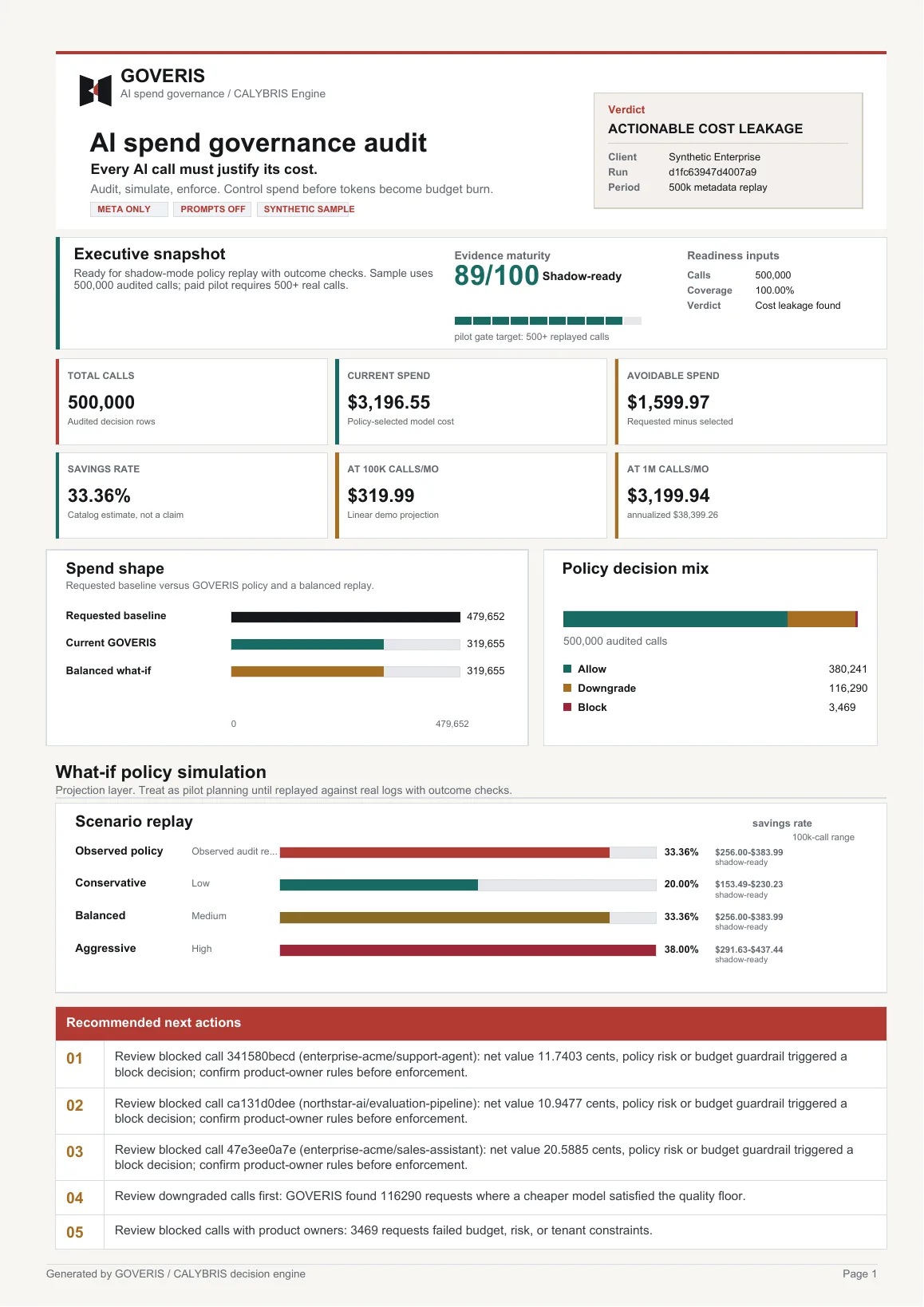
First page of the GOVERIS AI spend governance sample report

The deliverable

A board-readable report backed by replayable evidence.

Not another dashboard someone has to monitor. The audit tells you where spend concentrates, which policies are safe to test, and what evidence supports each recommendation.

  • Requested versus selected model analysis
  • Cost, quality, risk, and confidence trade-offs
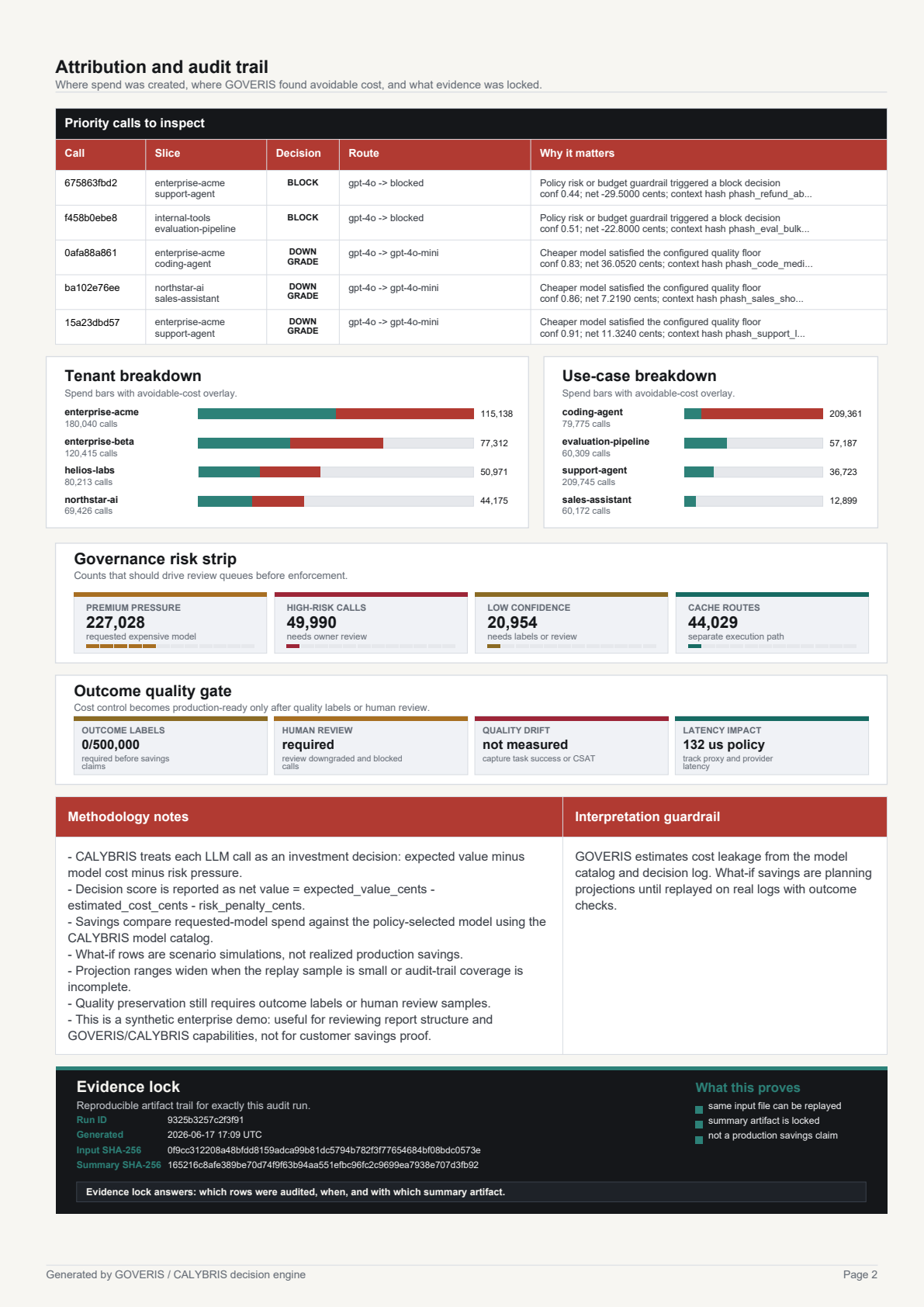
  • Evidence hashes and reproducible scenario methodology
Open the sample audit PDF
Decision trace Every call gets an audit reason.
Policy replay Compare cost, quality, and downgrade pressure.
Client package Deliver PDF, HTML, JSON, and artifact hashes.

Measured, not blended

Speed is reported at the layer where it was measured.

Kernel, durable HTTP, and storage profiles are separate experiments. These are three-run or complete-profile medians from one local host—not a cloud SLO and not a fastest-run screenshot.

Integer kernel
8.6M/s
3-run median · overflow-safe
Durable HTTP
6,084 req/s
c=128 · 1 ms mock
HTTP p99
44 ms
15,000 requests · 0 failed
Durable WAL
10,684/s
current contended host
Real data benchmark
1M rows
WildChat + OpenAssistant · 0 errors
Marginal savings
14–45%
over your existing routing · measured per customer
Kernel p99 (real)
152 µs
22-model catalog · SHA-256 proof
HTTP throughput
2,597/s
1M requests · 32 threads · WAL on

Real data benchmark: 1M rows (500K WildChat + 47K OpenAssistant + synthetic fill), 0 errors. Marginal savings depend on your current routing maturity: teams with no routing see ~44%, teams with basic routing see ~26%, teams with smart routing see ~14%. The shadow replay pilot measures YOUR actual marginal savings, not theoretical maximums. Measured on a consumer Windows host with NTFS storage. We publish local-host numbers, not cloud SLO claims.

Engineering proof 294 tests · fault injection · proptest · loom exhaustive concurrency
Hardened 10 critical fixes: WAL deadlock, NaN bypass, timing leak, CORS
Instant audit GET /api/v1/audit/report → JSON + Markdown spend analysis

Already using Helicone, LangSmith, or Phoenix?

They show what happened. GOVERIS decides what should happen next.

Observability tools tell you which model was called and how much it cost. GOVERIS tells you whether a cheaper model would have satisfied the quality floor, proves it cryptographically, and enforces the policy when you're ready.

Observability
Both
GOVERIS + Helicone can coexist
Prescriptive routing
GOVERIS only
auto downgrade / block / cache
Proof trail
GOVERIS only
SHA-256 sealed, audit-grade
No prompt capture
GOVERIS only
metadata-only by design

Executive control

GOVERIS explains where model spend went, then tests what should change.

The first product is not another chat wrapper. It is a private shadow-replay pilot for teams that already use LLMs and need evidence before they change a production route.

Find waste Premium calls without matching value

Detect low-risk, high-cost traffic that can be downgraded, cached, or blocked.

Defend spend Explain why expensive calls survived

Show the confidence, risk, latency, and quality constraints behind each decision.

Enforce policy Move from report to guarded gateway

Run in shadow mode first, then graduate proven rules into the proxy path.

What teams actually save

Three teams. Three problems. Real numbers.

These are replay-based projections from the GOVERIS synthetic benchmark dataset. Each scenario uses 500,000 decisions with realistic tenant, model, and volume distributions. Production results will vary. We don't claim savings until a real pilot confirms them.

SaaS support team · 50K calls/mo $1,420/mo saved

GPT-4o used for every ticket. GOVERIS identified 62% of calls as low-complexity, downgraded to GPT-4o-mini. Quality score unchanged. Monthly bill dropped from $4,200 → $2,780.

Legal AI copilot · 8K calls/mo $340/mo saved + risk blocked

Claude Opus used across all workflows. GOVERIS preserved Opus for contract review (0.95 quality floor) but downgraded research queries to Sonnet. Blocked 3 high-risk PII-adjacent calls per week.

Agent workflow · 200K calls/mo $8,600/mo saved

Multi-step agent retrying with flagship models. GOVERIS detected 41% of calls were repeated prompts (semantic cache eligible) and 23% used premium models for tool-call formatting. Cache + downgrade = 38% total reduction.

These projections use the GOVERIS catalog estimate methodology: replay existing traffic against conservative, balanced, and aggressive policy scenarios. We publish the methodology, not just the number. Actual savings require a shadow replay pilot with your production metadata.
01 Mirror metadata

Keep prompt content local while a private image observes decision envelopes.

02 Simulate policy

Compare conservative, balanced, and aggressive routing scenarios.

03 Shadow gateway

Replay traffic safely before enforcing model downgrades or blocks.

04 Control spend

Move from report to governed OpenAI-compatible inference.

The problem

LLM bills are made of thousands of unreviewed decisions.

Teams see the invoice, but not the call-level economics: why a premium model was used, whether a cheaper model would satisfy the quality floor, or which tenant is creating avoidable spend.

Premium misuse

Expensive models are used for low-value or repeated work.

No policy trail

There is no durable record explaining why each AI call was allowed.

Risk blind spots

Confidence, quality floor, risk pressure, and tenant budget live outside routing.

Client deliverable

From mirrored traffic metadata to a board-readable spend audit.

A private Docker image runs inside your environment, evaluates a metadata-only mirror, and keeps raw events local. Goveris produces aggregate findings and what-if policy scenarios without asking your team to export prompt logs.

Inputs

Mirrored model, token, latency, tenant, workflow, risk, and confidence envelopes.

Analysis

Savings estimate, downgrade pressure, negative-net calls, audit coverage.

Output

Local dashboard, aggregate review, recommendations, and what-if policy table.

GOVERIS spend audit shadow replay
Audit coverage 100%
Premium pressure actionable
Policy scenarios 3 what-if paths
Client gets Local dashboard, aggregate findings, policy recommendations
Proof trail input hash, generated artifacts, replayable decisions
deployment     private Docker image
data boundary  customer VPC
traffic mode   metadata-only mirror
prompt capture disabled
enforcement    off during replay
Sample audit PDF Graphical report package

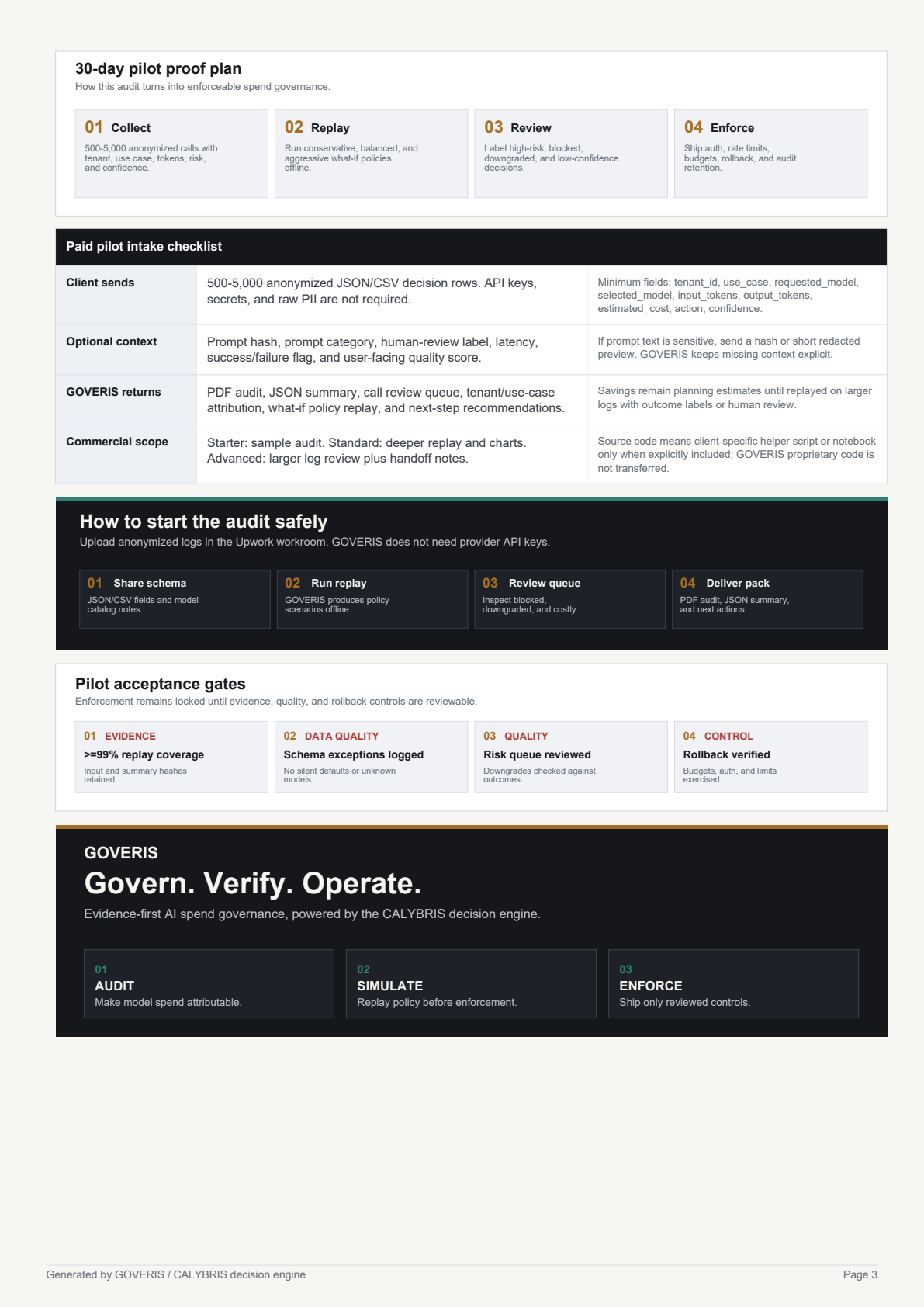
A client-facing example with spend shape, what-if policy simulation, tenant attribution, recommendations, and artifact hashes. The sample is deliberately marked as pilot data, not a production savings claim.

Total calls 500,000
Audit coverage 100%
Catalog estimate 33.36%
Requested baseline $4,796.52
Current GOVERIS $3,196.55
Balanced replay $3,549.42
Observed Conservative Balanced Aggressive
Open sample PDF GOVERIS sample PDF audit report preview

Platform workflow

Start with evidence. Enforce only after the policy survives replay.

Audit

Cost governance report

Find avoidable model spend without touching production traffic.

Replay

What-if simulation

Estimate conservative, balanced, and aggressive policy effects.

Route

CALYBRIS gateway

Allow, downgrade, block, cache, or retry each model call.

Private Docker shadow replay

Observe the economics without handing over production logs.

We provision a private image in your registry or VPC. Your gateway mirrors only the decision envelope—not prompt or response content. Calybris evaluates each call in non-enforcing mode and stores the replay trail inside your boundary.

IMAGEprivate-registry / goveris-shadow:pilot
INGESTmodel · tokens · latency · tenant · workflow tags
EXCLUDEDprompts · responses · credentials · customer PII
MODEobserve and replay · never alter the live response
OUTPUTlocal ledger · aggregate review · rollout candidates
  1. 01
    Deploy beside the gateway

    Read-only pilot image; no provider key is required for replay.

  2. 02
    Mirror metadata for 7–14 days

    Production traffic continues unchanged while Goveris evaluates alternatives.

  3. 03
    Review before enforcement

    Promote only policies that survive quality, risk, budget, and shadow gates.

Adoption path

Fixed scope. Clear price. No surprise integration bill.

Every package starts read-only. Savings are scenario estimates until your outcomes validate them.

Shadow scan $490 fixed

A focused metadata-only scan for one team that needs a fast, defensible spend baseline.

  • 7-day observation window
  • Up to 50,000 metadata events
  • 1 provider · 1 business unit
  • Executive brief + top 10 actions
Decision audit $1,500 fixed

The full private Docker pilot: attribution, proof trail, what-if policies, and board-ready reporting.

  • 7-day observation window
  • Up to 250,000 metadata events
  • Up to 2 providers · 3 business units
  • PDF + dashboard + evidence hashes
  • 3 policy scenarios + review session
Gateway readiness From $3,500

Provider contract validation and a canary-ready plan for teams considering governed execution.

  • 14-day technical engagement
  • Idempotency + timeout reconciliation
  • WAL recovery + load evidence
  • Canary, rollback, and SLO plan
  • Enforcement remains approval-gated
Enterprise · Custom Multi-team rollout, private registry, and deployment-specific acceptance evidence.
  • Custom event volume and retention
  • Managed PostgreSQL/KMS integration
  • Security and procurement package
Scope enterprise

One-command pilot

Deploy in your VPC with a single docker compose.

No agent installation. No log export. No prompt capture. Mirror approved metadata to GOVERIS for 7 days, then pull the audit report from the API.

Step 1

docker compose -f docker-compose.pilot.yml up -d

Step 2

Mirror metadata to POST http://goveris:8080/api/v1/route

Step 3

GET /api/v1/audit/report → JSON + Markdown audit package

Start here

Get your LLM spend audit in 7 days.

Book a 15-minute call. We'll scope the pilot, deploy a private Docker image in your VPC, and return a board-readable audit. No prompt capture. Metadata-only observation.

Early adopter offer First 5 pilots: Shadow Scan at $290

40% off the $490 Shadow Scan for early adopters who help us build the first case studies. Same deliverable, same quality, same private VPC deployment.

Claim early adopter spot

Live policy replay

Change the workload. Watch Calybris decide in real time.

The first scenario runs automatically. When a Calybris demo endpoint is available the decision is server-authored; otherwise the page uses the disclosed deterministic browser policy. Either way, the proof and decision factors appear immediately—without a paid model call.

Default on this page: deterministic browser replay Connect a Calybris demo endpoint and the same panel switches to a server-authored decision.

Decision ledger

Order-status request / support-emea / standard

evaluating
Requested
claude-opus-4-8
Selected
pending
Net value
--
Expected value
--
Estimated cost
--
Quality floor
--
Risk penalty
--
Proof fingerprint
--
Decision reason Waiting for evaluation. Fallback chain: --
/api/v1/route not evaluated
Waiting for a policy decision...

Synthetic data, disclosed

Realistic shape without pretending it is customer traffic.

The public dataset is generated deterministically from bounded distributions for token volume, model mix, tenant concentration, quality floors, confidence, and risk. It contains no prompts, customer logs, or personal data. Cost figures use the checked-in model catalog; savings are scenario estimates, not a production claim.

Public sample
500 decisions
Report replay
500,000 decisions
Deterministic seed
73,120,526
Workload mix
5 tenants / 5 use cases